Translate

Monday, 27 April 2020


Standing at the top of a beautiful ski run. You have spent all day preparing for this descent but the lifts are closing and the fog is rolling in, the slopes are too dangerous to ski on.  The only way back to the Gondola involves trudging uphill and a nasty rope lift that will shred your gloves.

All around you, people are setting off but as you wait you notice a few more cautious skiers are turning back.  It is possible if all goes well to get to the bottom but though enticing at the top the slope is marked as closed.  There are no rescue services and your insurance would be invalid.   What will you do?

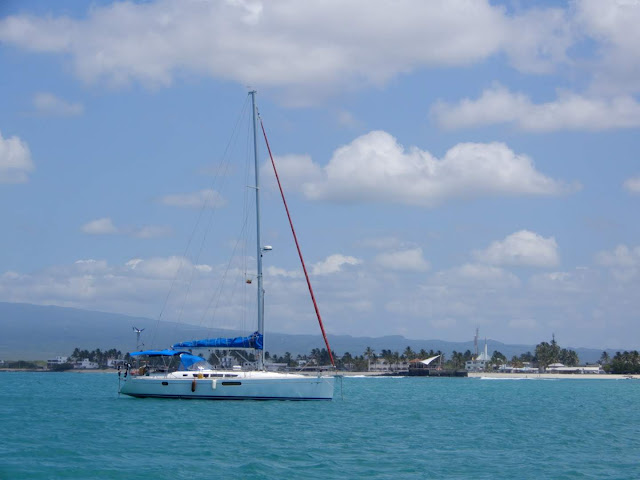
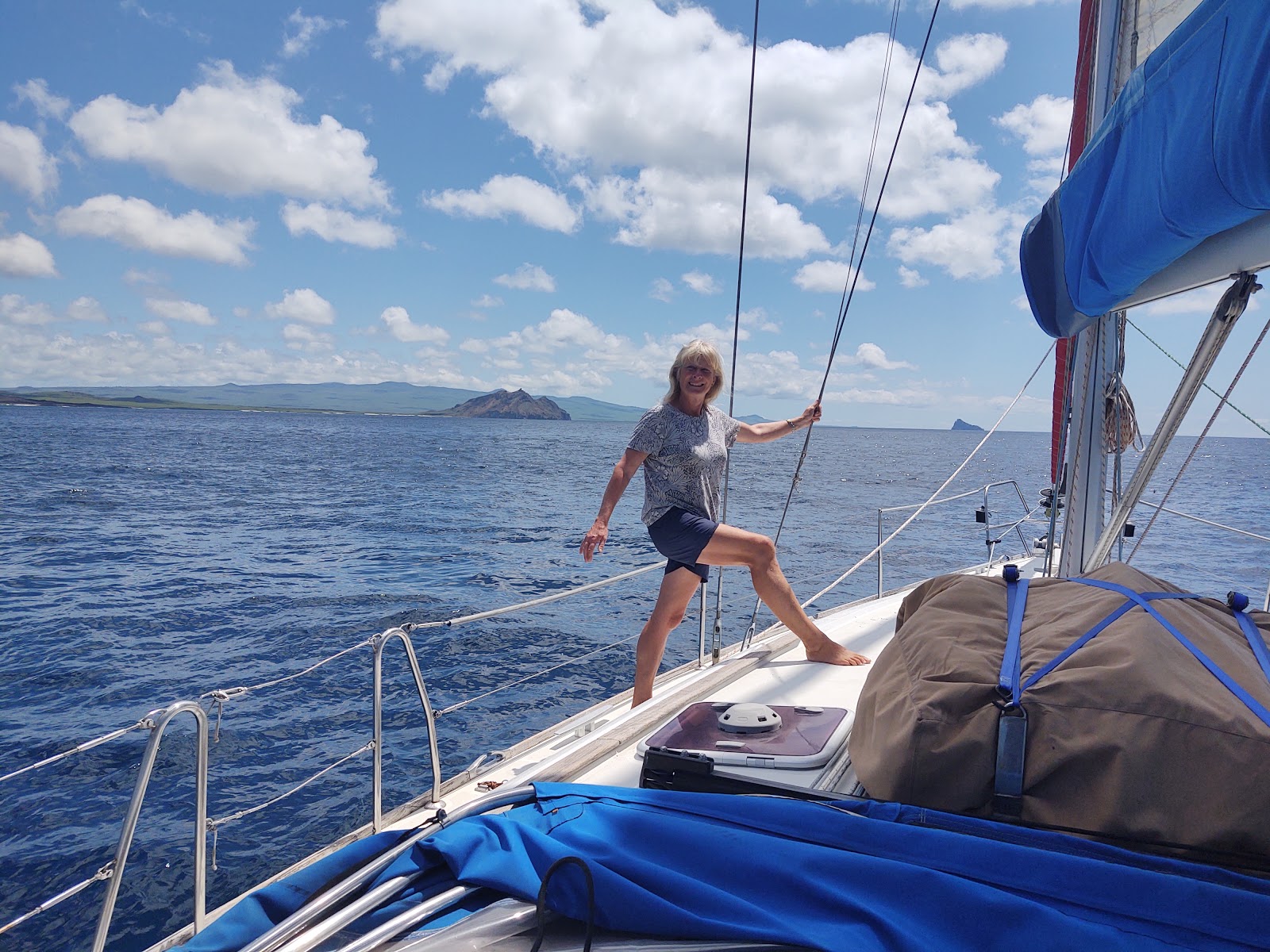
We are sitting at anchor in lockdown in a beautiful place, all ready to set off, everything was prepared for the passage across the Pacific, until without warning, everything closed around us seven weeks ago.


From our anchorage in Puerto Ayora, Santa Cruz we can show you pictures of the exotic bird and marine life that equal any that we have seen from elsewhere. The availability of sun-ripened local tomatoes and passion fruit may sound enticing but the reality is, that like everybody else that we know in the world we are locked down, restricted in our movements, aching to socialize, to get out into the local countryside, to come and go at will, to have some certainty in our lives, to swim further than three metres from the boat.


Pictures of French Polynesia look enticing and draw us on.  News that they are relaxing their restrictions makes this seem even more attractive.  We believe Australia and New Zealand will allow yachts in even if this is not yet certain.   Maybe the restrictions will lift as fast as mountain fog and inter-island travel will suddenly become possible.  We can still wait here no matter how enticing it looks.  Our decision timetable dictates that westward travel across the Pacific means departure by Mid June but this is too late to enjoy the Pacific. It is just the latest we could leave here and have time to reprovision and do some maintenance in Tahiti.  We now think Mid May is the latest we could go West and enjoy the Pacific.  If it is not open by then we will have to look the other way.


Turning Back - Are We Crazy?

Turning back isn’t the first option that comes to mind.  It is bad enough going back to collect some missing items that you need for a weekend away when you have just turned onto the Motorway and have to drive a further ten miles before you can turn back at the next exit.  From here it is a 600 or 1000 mile decision and a delay of nearly a year before setting off again.   The stock of food we have will go out of date, the maintenance we have done will have to be repeated.

We have set off already, we are ready to go but if we carry on across the Pacific and cannot stop in the islands we are trading a "short" sail of 600 miles to Ecuador or 1000 miles to Panama for one of 7500 to New Zealand.   We might miss out on some good island hopping this year if things open up and we set off by the end of May but then we might miss out on the Pacific completely if they don’t open up.  If we go back we can always explore Ecuador if or when that opens up and the Pacific will be there next year or the year after if we have to wait that long.  Perhaps it is not so crazy, turning around now we don’t lose our chance to see the Pacific, we only delay it.

There are downsides though to going East. Panama has some of the worst lightning storms, every day between now and December.  Ecuador has to open for us to leave the boat there.   COVID 19 is rampant in both countries and flights have not opened up.  The journey home will not be simple, even when flights start operating.  On the other hand, we don’t have to rush home on the first possible flight and if we can reach the marina in Ecuador it is in an isolated community. Like French Polynesia, the Governments in Ecuador and Panama have started to publish timetables for relaxing the lockdown, including the resumption of international flights, even if the conditions are very different.  Heading West we escape the virus, going East will be difficult every step of the way, including when we finally arrive home.

Today our decision is to wait with a focus on returning to Ecuador and backup of going West if it really opens up in the coming weeks. But this plan is written in the sand of a beach below the high water mark and things are changing fast.  Tomorrow there will be another tide and we will be forced to review our decision, with new information and a new perspective. One thing is certain. If, like the skier on the slope, we travel further west then it is too late to turn back.  This is the most compelling reason to stay for now and to look East when we are able to move on. For once down that first steep slope, there is no way back.


Saturday, 18 April 2020

Decision Update - When do we go? Where do we go?

Timeline to a decision

Our timeline to a decision has not changed but the passage of time brings new options and closes others.

End of April – our official clearance to remain expires.  With no formal extensions granted to yachts, no one has been asked to leave either.   We still hope we will be able to remain here until the end of May and maybe the end of June.  

Mid-June - If we were to go west mid-June would be a good time to leave especially if we can provision safely in Tahiti but French Polynesia is looking less and less like a good place to stop and there are no open ports beyond that.  So far there is optimistic talk of New Zealand opening following lobbying to allow this, but as of today its only talk.  The borders are closed, so are the Australian borders.  Mexico is stopping movements, it is in the hurricane belt and out of reach unless we could motor for up to 1000 miles, which we cannot.

Mid-June technically we can go East to Ecuador, except that that is closed too, even to internal traffic.  We might be able to reach Panama too though that is partially closed.   We are hoping we will be allowed to do this, additional risks of travelling to Ecuador include the severity of the Covid 19 outbreak there and the financial stability of the Government.  Flights home seem unlikely any time soon.

End of July – the last chance to sail safely across the Pacific.  We do not want to arrive in New Zealand or Australia in their winter either so timing will be critical.   If we stay later to go East and this is not possible then we will have to hope we can stay for a year, unable to move out of here from late September onwards because of the Cyclone season.  The boat will need significant maintenance for a safe Pacific crossing, and that is not possible here.

What are we hoping, a safe passage to Ecuador in late May or June.  Perhaps the second best is a safe way to leave the boat here, a great option if we can find a way.  The final fall back is sailing with an approved stop in French Polynesia, otherwise direct to Australia or New Zealand arriving at the end of October.


Thursday, 16 April 2020

Galapagos in Lockdown

Here in the Galapagos despite the lockdown and early curfew we have been treated exceptionally well by the community and the authorities. I am sure this is the case in many other locations where yachts are stranded in self-isolation. The question we may all be asking is how to give something back to the community. For us, the choice became easy, when news of a radio fundraising marathon reached us.
With the help of our agent, we were able to enlist the support of the deputy mayor, who prepared a special appeal in English so that we could understand a little better what the community needs were.  
It is easy to forget when surrounded by such beauty that the local community is devasted by the shutdown.  Over 80% of their revenue comes from tourism, the majority of the rest are Government funded jobs.   It is reported that about 3000 Government workers have not yet received their monthly salaries as the Government is prioritising health care.   In addition, there are some very poor communities, already dependent on food handouts.
With the help of the deputy mayor and a clear fundraising target, a near term deadline, a tiny bit of organisation and use of the local WhatsApp group we have been able to raise $1200 from the few boats that are currently maintaining self-isolation in the Galapagos. 
The deputy mayor in Santa Cruz and a deputy in San Chrisobal came directly to each boat to accept the donations and thank us personally. For me, their self-evident gratitude has made this a day to remember.

Meanwhile in this special place life goes on as unusual as always, the relationship between humans and wildlife is as unique as the wildlife is rare.   

Fish Market

Fish market

We are lucky and privileged to have ended up in self-isolation here. 

Monday, 30 March 2020

What a difference a day makes or When are we going to get there?


Sunday March 15th, we were normal tourists in the Galapagos.  We had taken a boat trip to Los Tunnelles to swim with sharks and sea turtles.  A brief look at life the day before lockdown:
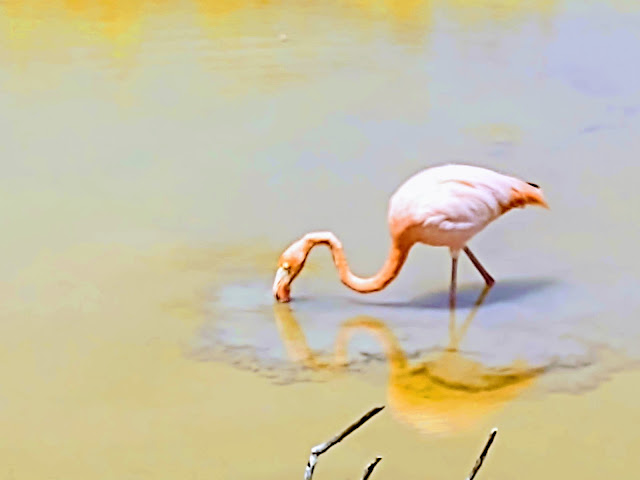
Flamingo


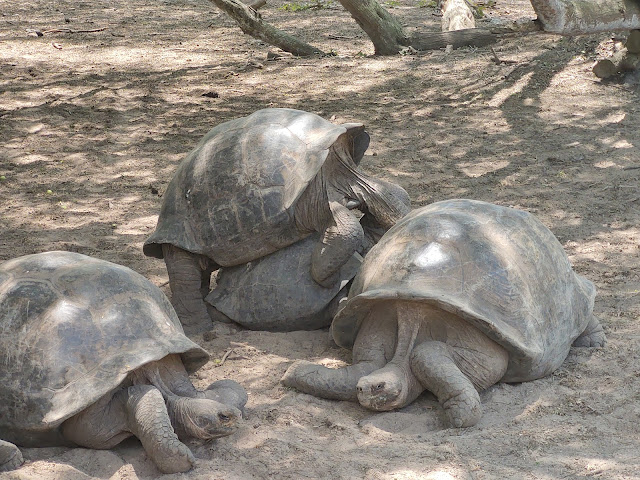
Doing his duty at the breeding centre - lots of grunting.

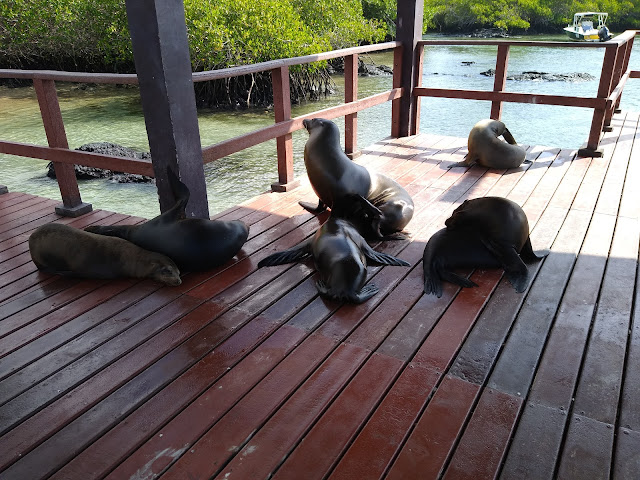
Taking Over the Dock Now the Tourists Have Gone

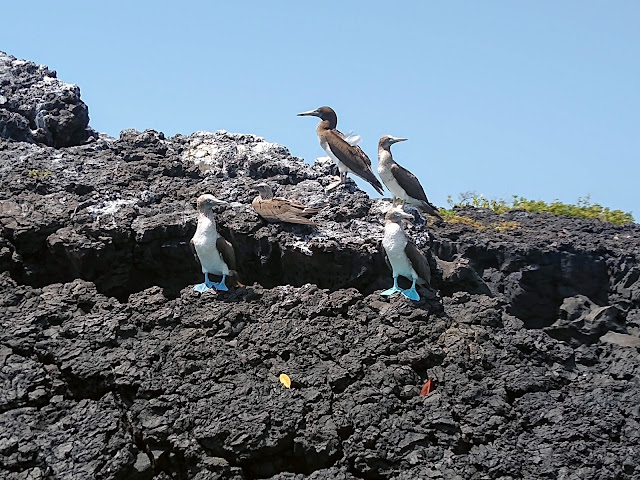
Young and Mature Blue Footed Boobies


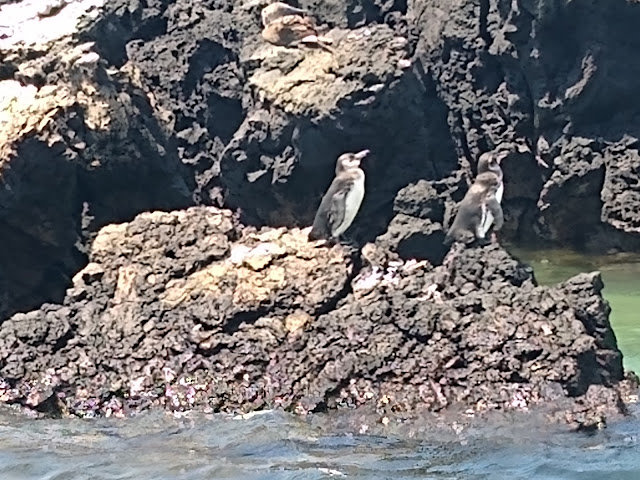
The most Northerly Penguins in the World


At Anchor in Isabella before the Lcokdown


Monday morning (March 16th) and our life was still progressing normally, the UK seemed to be taking a cautious approach to the introduction of social distancing measures and we were far from the worldwide outbreaks.  Normal that is, if living on a boat in the Galapagos could ever be described as normal.  We, along with the few people that arrived on sailing boats are the only people to arrive by sea, everyone else is dependent on the frequent flights to and from Ecuador.  Frequent until they stopped without notice that Monday leaving 2500 tourists stranded.  Most have now been airlifted out to Quito - where many will still be waiting for onward flights.

We were doing boat jobs after two days of tours around Isabella.  Mid-morning, we were told we had to move to Santa Cruz as Isabella was closing.  Later the same morning, we were told there was a lockdown in force, though it turned out that it didn’t start until Tuesday.  Tuesday did not seem abnormal to us as we motored the 45 miles to Santa Cruz to find the bay full of cruise ships that had been told to disembark passengers immediately so that they could catch the last flights out.   We had imagined that tourists would finish their holidays before returning home, we even thought the lockdown was in anticipation of problems not the discovery of cases of Covid 19 on the islands.

Acceptance of the new conditions comes slowly, the two-metre rule goes from an unknown concept to normal practice.  Things that one thought were impossible just a few days ago become the new normal.
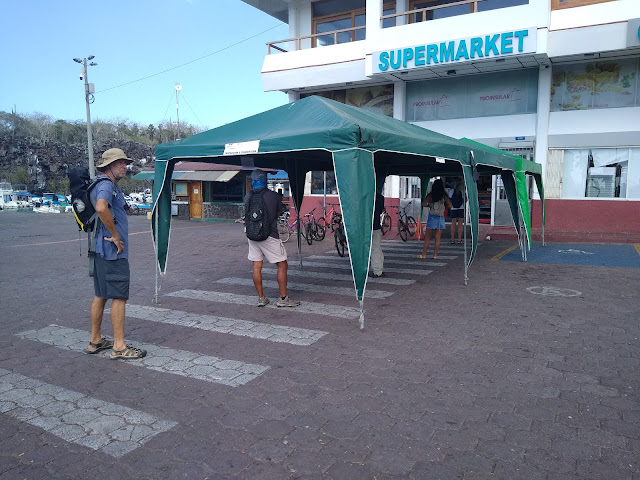
First exposure to the two-metre rule

It took a few days for the extent of the lockdown and seriousness of the situation to sink in, and each day for the first week one or two small freedoms were removed.   The slow steps seem necessary if the human mind is to keep up with the changes.   We are now under increasingly strict curfew, starting at 14.00 and ending at 0500.  Police appear in white suits to enforce the measures.


It was not until March 24th that we discovered that there had been four cases of Covid 19 on the islands.  Although we knew of cases that had left the island we hoped the early lockdown would have left us free of further community spread.  Now we are holding out for these to be the only cases.  The authorities have been very good at protecting us by making it clear that all the cases were among permanent residents and were linked to travel to the mainland.  In other Pacific Islands tourists are taking the blame for transmission so we are very fortunate.

We are 13 days into the lockdown. In that time the UK has gone from normal life to recommended social distancing, to complete lockdown. Unlike most countries, off-licenses in the UK are open whereas here alcohol sales seem to have been banned from yesterday, (except in the smart supermarket at the dock that doesn’t yet seem to have got the message, thankfully). Like the measures taken in many other countries, some of the measures seem targeted at enjoyment, not just social distancing.  There is a huge beach here that is out of bounds.  We are forbidden to use our kayak.  We hear of people in the UK being told off for buying charcoal as if having a barbeque in one’s own garden should be a sin and I am not convinced that driving is so dangerous that it is not worth allowing people greater freedom to choose where to walk.  I feel for city dwellers told off for leaving town but facing park closures. We watch with interest how the Swedish will manage under less severe restrictions, and watch the USA with horror.   As a side note, we learned today that Ecuador has more ventilators than the USA.

Shopping Covid 19 Fashion Wear - Mandatory face masks after a week without requiring them
Now we are adjusting to the likelihood of two weeks becoming four and when the next two weeks are over, I suspect it will be extended to six, eight and then twelve weeks.  Like going on holiday or life, the second half always goes much faster.  Even this second week of lockdown has progressed much faster than the first.   I am reminded of painful swimming lessons, no matter how many lengths you had to swim it always felt better when you were past half-way.   Maybe this is how we will get through it, when we are told it will be twenty-eight days, we will already be halfway and on the home stretch, though deep down it is hard to believe that there will be any return to normality before the end of the year..

It takes longer to appreciate the world situation than one’s own, though it helps if you are already locked down.  Those that are on passage to French Polynesia, our original next port, will be living normal lives. They planned to be in isolation for up to 30 days even if all went well but they are leading their normal lives and though it seems harsh to say, we can tell from their email messages that the world they re-surface to will cause real shock and anxiety.

On a personal level, Clare’s mother had a minor stroke.  In normal times we would have tried to return home at least for a short visit. For now,  Whatsapp and Skype phone calls have had to suffice. Clare is greatly relieved that her elder sister, Jill, was able to reach Cornwall and provide fantastic support at home, which seems to be helping achieve a good recovery in the last week.

Life on a boat in Isolation

A boat is a small place to be locked down, but we do at least have a big backyard. If only we could use more than 3 metres from the perimeter of the boat and that kayak. Our closest neighbours are a family of four with two small children and additionally their grandparents on board, a total of six, it helps us to appreciate the space we have.
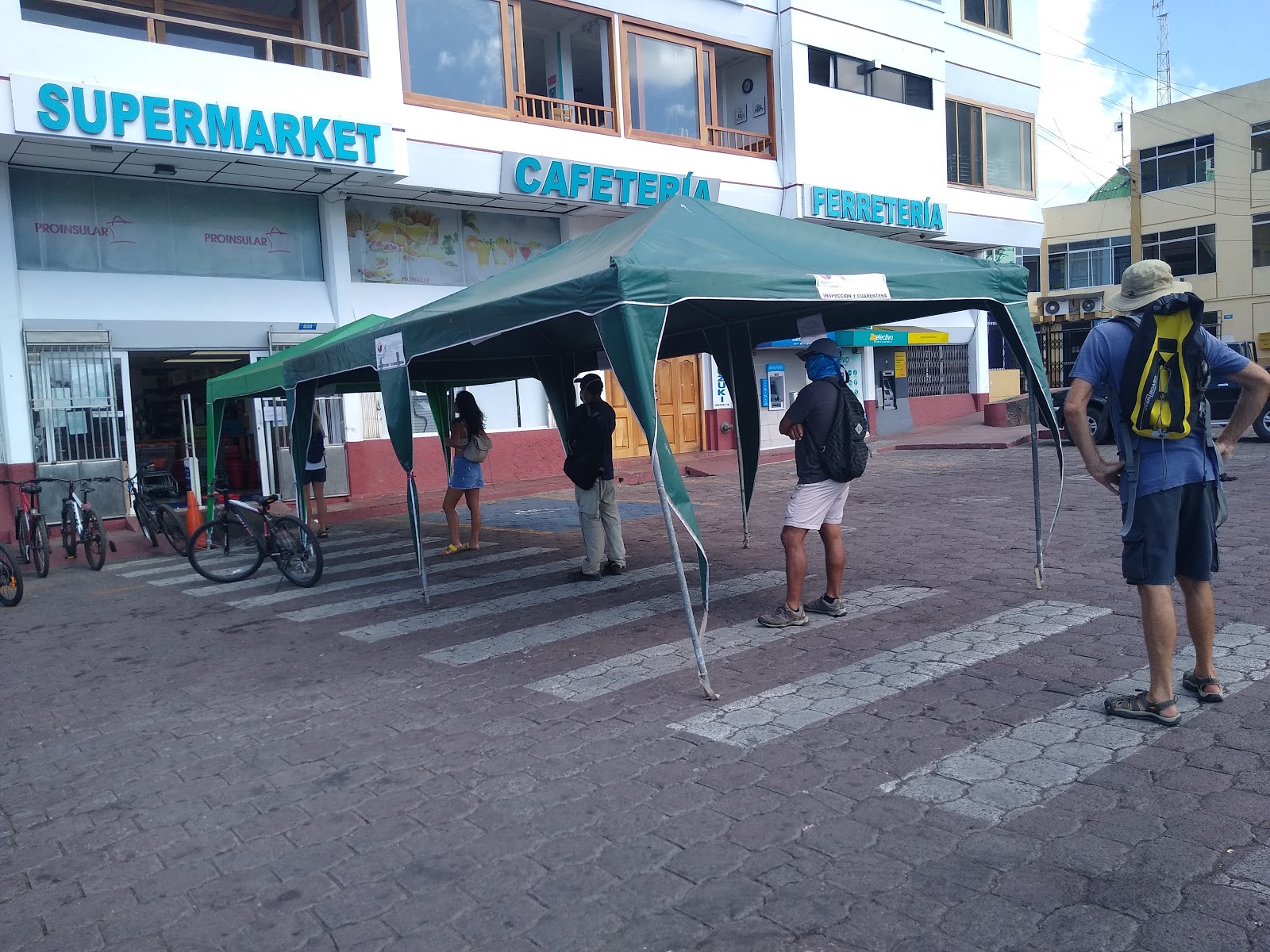
We have good, even excellent food supplies.  Fresh food is locally grown and good quality and being the Galapagos 100% organic. The bakeries are excellent.  Fresh fish is available in the fish market and local meat is both good and inexpensive.   A shopping trip last week was a bit of a scrum away from the smart supermarket at the dock. We think local people are beginning to tire of the lockdown.  Young lads were messing around loading their dinghies with supplies for the crew on the boats at anchor around us.  No face masks, no gloves, whilst we queued 2 metres apart waiting to enter the supermarket.  Up the road the other shops were a little chaotic, full of food and too many people.  Today the police are out in force, enforcement gets harder and the measures taken will grow tougher.  Life won’t get better soon but there is a chance that the virus can be beaten in a small island community like this.

We are also well served by the local mobile operator, providing reasonable internet connectivity and the ability to call home and stay in contact with friends. Using Zoom and other applications reduces the sense of isolation.   This has allowed us to run quiz nights using WhatsApp with the other boats in the anchorage, so far a traditional quiz night and Countdown.  Movies take us away from it all and remind us of life before Coronavirus.  Dish, the story of the Australian Space Telescope that enabled the first TV pictures to be seen live from the moon landings when the moon was particularly poignant, reminding us of Man’s greatest technological achievement and what can be achieved so quickly when people work together and take risks.  Aside from the huge and obvious risks of going to the moon, in a small way the team running the Satellite Dish also took risks with their lives and equipment on that day, it should not have operated in winds above 30 miles an hour, it was gusting up to 60 miles an hour on the day).  Risk-taking, whether it is accelerating vaccine testing, people working with the very ill or others serving in supermarkets or keeping power systems and transport networks going is what will get us collectively out of this pandemic.
We are self-sufficient in power and water.  We have enough solar energy to allow us to use an electric kettle and even cook electric, though we prefer our gas cooker.  The gas cooker, just two burners, and a tiny oven cost $1500, the electric ring cost $9.99 so cooking on gas had better be better.


Our water maker fills the tanks each day in less than an hour and uses so little power that the batteries keep charging even when it is running.  We have even had to disconnect some of our solar panels to stop cycling the batteries to full every day.  The sun is overhead now at noon as we have just passed the equinox and we are less than half a degree south of the equator, the rainy season seems to have ended early so we have blue skies every day. 
We can only hope these systems keep working as it is impossible to fly in any spares we don’t already have on board and having to carry water to the boat would be a significant issue.

The Galapagos still brings many pleasures.  For the last few evenings, the new moon and Venus have provided an awesome backdrop to the town at night.  
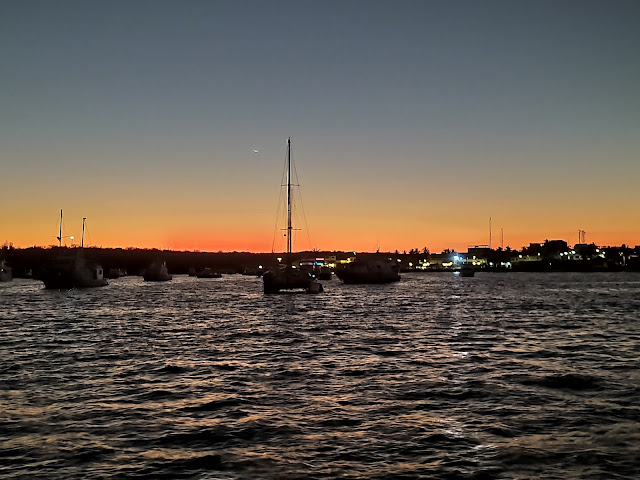

New Moon hanging over Santa Cruz
We had eight young blacktip sharks swimming around the boat, all trying to make a Pelican drop its fish as it recovered itself back to flight after diving in from high above us.  There are not many sea lions here but one comes to say hello most days.  It took up residence on our transom while we were watching a movie.  Flocks of small birds follow shoals of minnows, almost walking on water as they pick them out – the minnows trying to escape larger fish that have herded them to the surface, Pelicans eying the larger fish for their dinner and there are boobies occasionally flying overhead.   Sealife in the Galapagos is awesome.


Where are we going next?
Nowhere, not soon anyway.  The Pacific is closed.  Central and South America and the USA are either closed or out of reach. (edit 17/04:  With a review of expected winds and currents in June/July and August we think Ecuador is a very doable sail and Panama might be reached too).  The currents, winds and looming hurricane season in the Northern Hemisphere make going backwards seemingly impossible.  Our insurer has said “no” to any insurance on the west coast of the USA or Mexico.   We will continue to review this option but we suspect that there will be too much uncertainty to take the risk of going East before it is too late.  Australia is partially open to us we think but New Zealand would be a better destination, even though it is closed now.  It's just 7500 miles if we have to sail it non-stop.  We can provision for that long at sea if we have to but it is not what we are planning, yet. 

We can’t stay here indefinitely as the boat will need maintenance that cannot be performed without a haul-out.  We will investigate even that but even if it were technically possible it seems unlikely it would be allowed, but then everything that is happening around us seemed impossible even a week ago.

Timeline to a decision?

End of April – our official clearance to remain expires.  We hope and believe it will be extended to the end of May and maybe through June.  This is the last chance to head east before the Hurricane season.  The lack of assured entry to any country, Coronavirus, and a realistic passage plan probably elude us.

Mid-June would be a good time to leave especially if we can provision safely in Tahiti.  Safely means being allowed to stop and not being at any material risk of catching the virus before we depart. (edit 17/04 - also good for Ecuador and possibly Panama).


End of June – probably the latest we can stay in the Galapagos but who knows what the authorities will decide by then. 

End of July – the last chance to sail safely across the Pacific without stopping.  We do not want to arrive in New Zealand or Australia in their winter either so timing will be critical.   

We hope that by November things will be easing around the world.  In the meantime, we are hoping the Galapagos becomes virus free and healthcare developments in the rest of the world allow normal life to resume again.  When are we going to get there, after many false summits and half-way seems a distant memory.  Be positive, enjoy a look back..


Saturday, 21 March 2020

Lock down....Where Do We Go Now?

On February 4th as we drove to Heathrow to start the next leg of our adventures on Tintamarre we listened to some news items on the repatriation of Brits evacuated from Wuhan Province, China. -  and  had our first introduction to coronavirus and isolation.  Although we muttered darkly to each other how global air travel would surely lead to this beast spreading worldwide we could not have guessed that just six weeks later we would be on lockdown in the Galapagos.

The last week has brought a mind-blowing change to our lives. (and yes, we know also in the lives of all our friends all over the world). Last weekend we took two wonderful trips from our anchorage on Isabella Island, and swam with sharks and turtles, watched the blue-footed boobies, 


and walked through beautiful lava fields.


Then, as we settled into boat jobs on Monday we received instruction to leave Isabella immediately and sail to the main island of Santa Cruz. We understand that there has been a case of coronavirus (a tourist, who has now left) and there may be an elderly gentleman who is also ill.  Later we were told everything would be shut from Tuesday and all inter-island travel would be banned, though we had to break this particular embargo to comply with the first instruction.

The islands have been emptied of tourists. A small number who failed to get on flights remain - they form a hopeful queue at the travel agents. Lockdown is taken very seriously here.


A curfew is in place from 4pm to 5am. Only food and drug stores are open. All other businesses are closed. Many wear face masks. Social distancing is totally respected. Hand sanitizer is used liberally. We are expected to only go ashore for essential supplies. At the moment there does not appear to be any shortages, but one must queue and sanitise to enter the store.  Other stores are less strict but there is great fear amongst the local population and everything is done at least at arm's length.


The anchorage is something of a carpark, filled with idle tour boats. However, as Tintamarre bobs gently behind the reef we can watch turtles, sharks and an aquarium of fish.  There are just six cruising yachts left here. We all face the same dilemma. What next? 


Our situation is this: Our visa (autografo) expires on 25th April. If we are not invited to stay beyond this date we have nowhere to go. We had prepared in every way to sail 3,000 miles to French Polynesia, and then onwards from there. But French Polynesia has, as a small island nation, with limited food,  fuel and health resources, not surprisingly closed its borders to new arrivals and imposed a regime which no-one would choose. (We have heard that the island supply vessels have been barred from leaving port for the next 30 days). We would likely be forced to abandon Tintamarre to a dodgy anchorage without insurance in a cyclone zone or be forced to sail another 3,500 miles to New Zealand in adverse weather conditions.  Except that we believe New Zealand is closed to non-residents.  We can cross the Pacific from around Mid May but we don't want to arrive in the storms associated with winter in New Zealand.  Perhaps Australia is a better option but their borders are also closed.

There are frequent updates, each one spawns a surge of misinformation on socal media. But generally the restrictions get tighter with the passage of time.   We worry for our friends who are at sea heading towards Hiva Oa, the first landfall in French Polynesia,.

If you look at your world map and think we should sail for the South American coast be aware that it is not possible to sail against strong currents and winds. And in any case most borders are closed. Mexico is currently an option, but it would take at least 2 weeks to reach there, and in that time frame there is no guarantee that its borders will remain open. We have read of sailing vessels reaching their destination and being turned away - a nightmare scenario.  The general advice is to stay put.

Despite all the uncertainty, we are grateful to be in a good anchorage where the authorities appear to be helpful. We have the company of a handful of other cruising yachts who face the same dilemmas. We are not allowed to socialize on board but we speak to each other by kayaking between boats. We have a virtual quiz night planned, and we have a lively WhatsApp group chat. The island looks beautiful. If we are lucky we may even get the chance to explore. For now, we enjoy watching the turtles and frigate birds from our deck. We do not need much from the island community here. We are self-sufficient in power and water, and we have at least 3 months worth of provisions on board, which we can supplement with locally grown vegetables and fresh bread from the shore.


When we feel down about our position we only have to remind ourselves how much worse it is for others.   How bad can it be to be stranded in the Galapagos? No one seems to know what the exit strategy is but we take comfort from the rapid improvement in China, where computers are seen going about business normally and the rate of new cases has slowed to a trickle.

Monday, 9 March 2020

360 Tour of San Cristobal

The Galapagos islands quite rightly have a very strict rule set. Gaining admittance  to the archipelago  was one set of challenges. 

Another rule is that cruising yachts must stay in one of three designated anchorages in the islands. So, no exploring the coastline solo. (One of the pleasures of our arrival was our cruise along the coast).

To see the coast from the water we had to take a tour. In San Cristobal we opted for a 360 tour which would take us right around the island...a long day trip in a powerfully engined boat. Tours are also rule ridden...no more than 10 tourists per Official Guide.

Our boat left the dock at 7.30am. Just over half an hour later we were arriving at the most spectacular snorkelling site. Named Kicker Rock or Leon Dormido (Sleeping Lion) this volcanic tufa plug rises dramarically out of the sea, with deep deep water all around.


There was no possibility of our boat dropping its anchor. Ten slightly nervous tourists jumped over the side of the boat, following our guide. 


Our guide was a very talented guy, able to spot wildlife above and below the water and lead us to it,  tell us about what we saw engagingly in both English and Spanish, keep tabs on us all to ensure our safety, and furthermore was able to shoot lots of footage of our group and the wildlife we were observing. 

We swam towards the towering island rock, swimming for a while alongside a Galapagos sealion, who chose to keep us company,  and then into the narrow canals between the three huge tufa rocks.


Within a short period of time we had watched hammer head sharks (with their impressive and unmistakeable hammer shaped heads, gliding around a couple of metres below us. Smaller, more conventional-looking  black tip sharks, and Galapagos sharks swam nearby. 


Shortly, a large eagle ray swam close by. In addition to these very exciting species sightings there were hundreds of other fish, of all shapes, colours and sizes. It would have been wonderful to linger for longer – but the best we can do is return for another visit. As we emerged from the canal into open sea we were joined by a couple of large turtles.


Our next stop at Sardine Bay took us to a beach with the most gorgeous powdery white sand. This sand is the product of parrot fish, who feed on the coral and then excrete this white powder. We were walking on luxury poo! – the rules were strict, bare feet only on this fabulous sand. No shoes!  We enjoyed an unguided snorkel - seeing lots of huge parrot fish (of course) as well as colorful damsel fish and so many others that I couldn't  identify.


Our boat took a ten minute pause at the Eastern most tip of the island, Punta Pitt for us to watch the booby birds.  The blue footed boobies get their distinct foot coloring from the lipids in their fish diet (deprived of fish, the blue fades) Whilst we could see the red footed boobies (who have a diet principally of squid) they were too far away to take a decent photo. Hopefully we get another chance some time soon.


As we pulled away from this point we were suddenly surrounded by dolphins. Hundreds of them surrounded our boat, leaping and playing all around us. Our boat spent quarter of an hour circling the area, so we could enjoy their company.


This end of the island, (south and east) is barren. Rainfall is very slight compared to the western end (explaining why the villages have grown up where they have)


Our last stop of the day was at this sea lagoon, accessed by a walk over a black lava footpath, past tall cacti.


Here we hoped to spot some white tipped sharks. But this is not the zoo, and we didn't get lucky on this score today. Instead we enjoyed watching huge - and we mean huge - yellow back turtles, feeding and meandering through the rather murky waters of the lagoon.


Then it was an exhilarating fast ride back to port, with 600 hp of engine behind us. Turned out it was a great day to have chosen for the trip - not only did we see so much wildlife, but also we appreciated the blue sky day on the sea....it had bucketed with rain on land!


Saturday, 22 February 2020

Passage to the Galapagos and story of Birdie

After three weeks in the marina preparing for the Pacific we left Panama in a process we defined as "Splash and Dash", to ensure that there was no time for marine growth to gather on our hull, for we had to be sure of arriving in the Galapagos with a clean bottom.  Our optimised process Checking out in Panama Ciry on Thursday, splashing on Friday and sailing on Saturday.  This relied on us being ready, the final boat preparations going without a hitch and the weather being compliant.   

Splashing at Vista Mar is somewhat unusual or perhaps heartstopping, here Clare is holding on to avoid slipping back into the cockpit.


We engaged MetBob for a passage route, which surprisingly stated that it would take 5 days when all our software based planning was for a 6 to 7 day passage.  What boat speed was he thinking of, at least we knew the weather window allowed us to leave a day later so we didn’t need to worry about taking longer.

Final provisioning complete we left the marina around midday looking a little low in the water.


The trip was very comfortable despite starting our second day with a near Gale (sustained 35 knot gusts)


 and then learning how to sail in very light winds and strong currents, but it will be remembered for being one of our easiest passages and for the story of Birdie.

As the winds calmed and as dawn broke on our third morning we noticed a young gull had taken up residence towards the bow.   Gingerly this gull, quickly named Birdie, moved forwards.  We were shocked to see it had a fishing line tight around one of its legs.


A day of edging closer and then pulling away got us to close proximity by lunchtime, helped by a few breadcrumbs.  Thanks for Bryana for on line veterinary support, Birdie seemed to know we knew what we were doing.  When first presented with a large blue towel Birdie shied away from us but then came closer still.  We became aware that we were being checked out by a small animal that didn’t know whether it could trust us but equally seemed to know that it had no option.


Moving bravely into the cockpit.
Free at last and now moving back to the bow of the boat
As dusk drew closer we sat down to eat, something we try to do before dark as that makes dinner a pleasant end to the day and start of the more formal overnight watches.   Birdie came closer, drawn in by the steak we were eating and impressing on us an increasing sense of urgency, with Clare holding the towel, Birdie allowed us to pick him up.  We had considered wearing protective glasses in case he became scared and tried to attack our eyes but he was totally calm and for the intricate operation I needed as good vision as possible.  The fishing line was tightly looped and knotted around his legs, each thinner than the line itself.  With large wire cutters needed to cut the line an advertent amputation would have been so easy, but Birdie remained calm and when I reached the final knot he pushed his leg out straight so I could access it easily.   We removed the final knot and let Birdie go.

He walked about a bit, took to the air and then to the water.   Now, this is not a Disney movie so there was no music but in a completely surreal moment 10 to 20 dolphins leaped out of the water and played along side us and Birdie for a few minutes until darkness fell.

Birdie spent most of the night with us, watched us perform a major sail change at around 2.00 am and sometime later left us, we hope for a long life at sea.

We sailed on into lighter winds and some motoring but in strong currents continued to make good time.  We crossed the equator at around 0400, despite the early hour we managed a brief ceremony being "griffins",  not entirely up to the standards of that reported by Darwin on HMS Beagle.

"A similar ceremony took place during the second survey voyage of HMS Beagle. As they approached the equator on the evening of 16 February 1832, a pseudo-Neptune hailed the ship. Those credulous enough to run forward to see Neptune "were received with the watery honours which it is customary to bestow".[2] The officer on watch reported a boat ahead, and Captain FitzRoy ordered "hands up, shorten sail". Using a speaking trumpet he questioned Neptune, who would visit them the next morning. About 9am the next day, the novices or "griffins" were assembled in the darkness and heat of the lower deck, then one at a time were blindfolded and led up on deck by "four of Neptunes constables", as "buckets of water were thundered all around". The first "griffin" was Charles Darwin, who noted in his diary how he "was then placed on a plank, which could be easily tilted up into a large bath of water. — They then lathered my face & mouth with pitch and paint, & scraped some of it off with a piece of roughened iron hoop. —a signal being given I was tilted head over heels into the water, where two men received me & ducked me. —at last, glad enough, I escaped. — most of the others were treated much worse, dirty mixtures being put in their mouths & rubbed on their faces. — The whole ship was a shower bath: & water was flying about in every direction: of course not one person, even the Captain, got clear of being wet through."  (Source wikipedia)


Later in the morning of our fifth day we realised that we could arrive before dark.   We passed Kicker Rock, famous for hammerhead sharks and enjoyed a gentle cruise down San Christobal.

5 days and 5 hours and 910 track miles after leaving we dropped anchor on San Christobal island in the Galapagos, awaiting with trepidation our bio security inspection on Friday morning.  Our fastest and most comfortable passage to date.