Translate

Monday, 5 July 2021

Recovering from 7 months in Storage


Boats don’t like being left alone, especially in a working yard.  Dirt gets into everything that water and wind will carry it and insects reach beyond into the tiniest hollow or to block any exposed inlet or outlet.  Corrosion continues unabated, in the warm, salty air of the South Pacific summer.   Tintamarre was well looked after and covered from the power of the tropical summer sun.

We arrived back at the boat in early June and despite a long-planned maintenance list Tintamarre was ready to splash within 10 days of our arrival.   The maintenance list was extensive, but the yard had been efficient and had everything in hand so that we were not delayed in launching.  The new sail and sail bag were fitted while we were in the launching dock and then we were free to leave for the anchorage.  What could possibly go wrong?

Time to Splash - Down the ladder for the last time this year (we hoped).

Just room to manouevre the boat out of the yard

About to Splash


Installing a new autohelm computer in our cabin


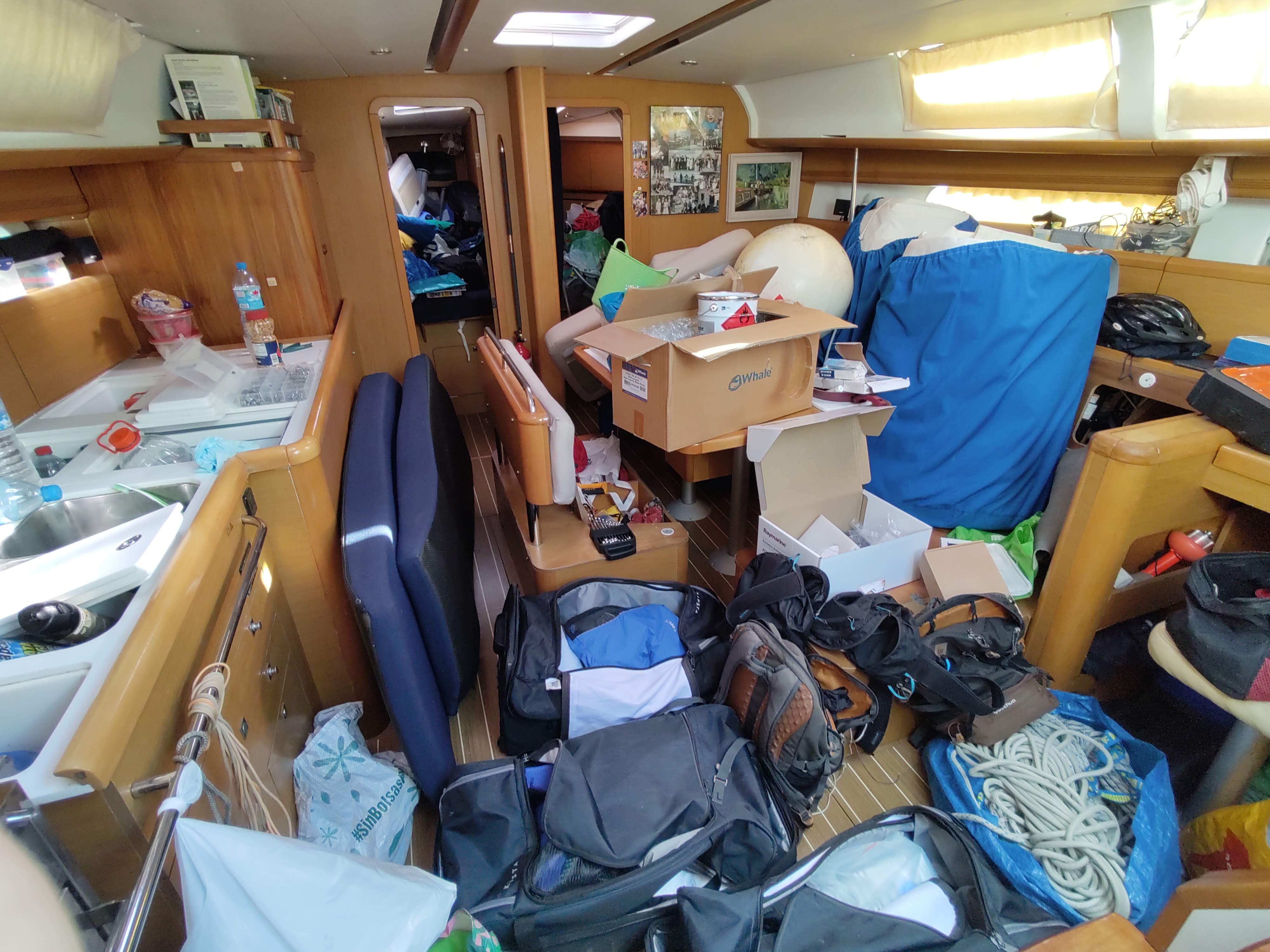
Main cabin, storage, workshop and kitchen 


We had planned for a few weeks at anchor close to the yard where we could buy spares and get assistance with any small issues that needed to be addressed before we could set off for Huahine or Bora Bora.   What we had not planned for was for our dinghy to be T-boned on the dock, the front tube bursting at the seams and looking as deflated as we looked when we returned to the dinghy with a week’s shopping and two bicycles to transport back to the boat.  With assistance from Minke and Jaap on Eastern Stream, we were able to return everything to the boat and haul the dinghy on board waiting for repair.

Awaiting a Pressure Test


The Russian glue that came with the dinghy was old and more like polystyrene cement leftover from the days of making Air Fix models.  Glue was soon everywhere but in between the seams where it was needed.   A tougher approach was needed.  A two-part glue was ordered to arrive by ship or maybe by air from Tahiti and minor surgery performed on the dinghy to allow better access to the seams.   Sadly, no matter how effective the gluing turns out to be the dinghy is now sporting its first few inevitable patches.

The anchorage is well protected from the ocean swell by wide reefs but suffers from strange currents, that are in part tidal and in part caused by the outflow of water arriving within the lagoon from waves breaking over the reef.   These currents cause Tintamarre to dance around one way until the wind blow against the current and then we dance in the opposite direction. Heavier boats, especially those with long keels, tend to sit with the current.   Instead of being 70 metres from the closest boat, we found ourselves about to collide, at two in the morning.   We had to move.

To set the anchor you reverse back with increasing power, helping it dig itself in and testing that it is holding at the same time.   Except for this time, we seemed to spring forwards, the current couldn’t be that strong.   Disorientation and cognitive dissonance take over, but eventually after revving the engine, trying forwards gear the only remaining explanation is that the prop has fallen off.  A quick dip in the water and sure enough, no propeller.   We were though anchored even if the anchor was not fully set, and it was between 12 and 20 metres of clear water beneath the boat.

The yard did a magnificent job of recovering the propeller and rope cutter and then pushing us into the haul-out dock with a small dinghy for the propeller to be replaced.   The cause, someone (Curacao, Guatemala, or Panama) fitted too small a locking bolt.   We are lucky this happened on a calm day in clear water, close to a maintenance yard.   Anchoring in a strong wind, close to a reef this might have been very different or simply losing while sailing and starting the engine expecting power on the approach to an entrance to an atoll in breaking waves.   From now on we will check that we have power and not simply that the engine starts before starting a difficult manoeuvre.

Deja Vu


Back in the anchorage, the same day, we noticed a small coolant leak from the engine.  The wind a current continued to confuse us and we were up for a few hours motoring away from two boats that refused to dance to the same tune as us.   Whilst we were able to use the engine,  coolant was leaking and evaporating faster than I realised.   What should have been a simple fix required half the cooling system to be dismantled and glued plumbing connections replaced with plumber's tape.  Again, some poor work, this time directly attributable to when the new engine was installed.   Glue is not a substitute for plumber’s tape.   The joints had come loose when the hoses were removed as part of a major engine service and once the glue seal was broken nothing except stripping down and starting again will fix the problem.

Two weeks on and we are still at the same anchorage, on our second attempt at fixing the dinghy and now waiting for a part to fix a fuel leak on the backup outboard engine.   The electric Torqeedo (outboard) is making some horrid noises from its gearbox – I think it will soon be on the maintenance or replacement list.

With lots of small tasks to be done onboard our days remain busy, and we have found this anchorage to be pleasantly sociable.  Strong winds have pinned us down in the boat for a few days too, progress is slow but exploring is still ahead of us.  Just one more push and we will be sailing….

Views from the Anchorage


Sunday, 4 July 2021

2021 - Paused in French Polynesia

Following the death of my father in September our plans for sailing further into the Pacific became plans for spending a few months in the UK, extended by Covid travel restrictions to become seven months.   We are now back on the boat in maintenance heaven preparing for a few months sailing round in circles within French Polynesia – given French Polynesia occupies a sea area the size of Europe and comprises three main island groups each with their own unique features we should not be wanting for new experiences.

Many have left this year for Fiji and New Zealand, and this was certainly our plan but the need to be able to travel home for family reasons means we must stay put as nowhere else allows return travel. 

The timing of the cyclone season and the continuing travel restrictions in the rest of the Pacific means that we will delay our passage west until this time next year.   We hope by then that countries will have started to emerge from the Pandemic, meaning we might be able to stop at Pacific Islands along the way to Fiji, New Zealand or Australia.  Let’s hope the vaccine roll-out accelerates and vaccine hesitancy, which is a significant issue in all the Pacific Islands is overcome.

Wednesday, 30 June 2021

Raiatea and a Chance to take a Trip back to the UK


Amazing good luck and a bit of persistence on our part got us a spot in one of the boat yards on the island of Raiatea (about 110 miles west of Tahiti), and therefore an unexpected opportunity to take a trip home to the UK. It was a surprisingly unpleasant sail from Tahiti to Raiatea.

On arrival  we enjoyed a few days of exploration, including a visit to the marae ruins of Taputapuapea at the southern end of the island. This Unesco heritage site was the Pacific centre point for learning and culture c 1000AD, where priests, navigators and the learned would gather to share knowledge and offer sacrifices to the Gods....Human sacrifices were apparently a thing here.

https://en.m.wikipedia.org/wiki/Taputapuatea_marae   - for more information!

A hike up the hill behind the ruins gave us a fantastic view of the reef surrounding the island, and making clear the pass for boats through the reef (light coloured sea is reef, darker blue is deeper (safe) water)


We also took the dinghy up the Faaroa River...which felt wonderfully exotic...to the botanical gardens. 


Preparing Tintamarre for a long spell in the yard is always hard work. We are used to having a marina conveniently close to the haul out yard, for easy removal of canvas and lines. But The Carenage doesn't have this facility;- our first challenge. Our second challenge was that the boat lift was super small. Can you see the problem Tintamarre will have being removed from the lift?

Both the wind generator pole and the back stay had to be removed to extricate Tintamarre. (Very happy to say that the yard now has a super new lift!)

We spent a few days preparing Tintamarre for her rest here. Sails, lines, solar panels, bimini and storm hood all packed away.


Meanwhile another covid lockdown looked like it might scupper our plans to travel completely, with the threat that all inter island transport would be suspended. We needed to get to Tahiti to get the plane home. Fortunately we were able to bring our flight from tiny Raiatea airport to Tahiti forward. 

We caught our flight back to the UK ok...albeit running late by 24 hours....but that's another story!


Time on the dock in Tahiti

In our grand plan we had thought we would carry out substantial works on Tintamarre in New Zealand. By mid August it was becoming plain to us that the New Zealand border was likely to be closed to us this year, due to strict covid-19 related border policies. Therefore we decided to bite the bullet and find a spot in the inexpensive but handily situated marina in Pape'ete and work our way through the job list here. 

Pape'ete (pronounced Pappy-etey) is the buzzing centre of French Polynesia. After the remote and sparsely endowed archipelagos of the Marquesas and Tuomotus it really does seem to be the last word in Metropolitan glamour, with large supermarkets and chandlery stores, boulevards and colonial style administrative buildings, a small cathedral and a humming big ship port.


At the top of our list was replacement of some of our rigging. The inner Ds had been replaced in Guatemala last October. Despite the fact that rigging should last for ten years, this new rigging wire had started to fail already. 

We realised that because our original plan to visit the UK in December was going to be impossible and we were going to run short of various essential supplies. Health check-ups that we had scheduled for our planned trip home would have to be carried out in Papeete. We discovered that the dentists here are excellent (and that appointments are readily available), doctors can also be seen easily, and most medications can be readily obtained here at surprisingly reasonable cost.  For Clare supplies of contact lenses were essential. 

We had long been considering replacing our old 20 kg delta anchor with a 25kg Rocna. The heavier weight of the anchor is of only of slight significance as the boat relies also on the weight of our heavy anchor chain to keep us secure. The Rocna is generally deemed to "set" better, having a roll bar to roll it into position, and a sharper point to help it dig in. We had to wait a while for the anchor to arrive by ship, and carried it back excitedly to Tintamarre. We had measured our bow roller set up carefully, so we were confident that it would fit. However, it then took us several hours of trudging around the marine stores to find a shackle of the appropriate size and quality. I cleaned up our rather rusty looking old anchor and quickly found a buyer for it.


We explored the options for our sails. Repair or renew? Our research took us to the Tahiti sail lofts and also had us researching the possible purchase of new ones. Buying sails is a good deal more complex and expensive than I had imagined. Our research indicated that it was probably worth fixing the genoa and replacing the mainsail, which needed to have every seam restitched to extend its life much further.


Our antifouling was looking very patchy - and was not going to see us through the next year. Also out sacrificial anodes needed to be replaced. Both jobs require Tintamarre to be hauled out - but with all the boat yards in French Polynesia full this seemed like a challenge. Eventually we secured a spot in a yard in Raiatea for a week in October. Our antifouling paint of choice was due to be delivered into one of the local chandleries in a workable time frame. We put in an order.

We researched insurance to give us cover against cyclones in French Polynesia. A requirement would be replacing all our rigging. Rigging parts needed to be ordered in from Europe.....as the work had to be done in the marina, and a marina berth can't be booked, we were obliged to continue our stay in the marina, waiting for the delivery.

Another project was to renew substantial parts of our boat wiring. Just as a domestic rewiring project can cause chaos, boat rewiring inevitably requires turning the boat inside out. Our cabin, which houses our battery charger, solar energy controller and access to the batteries needed to be deconstructed each time the project was progressed.

Life wasn't all work and no play. The marina was a sociable and safe place to be, somewhat reminiscent of a village. We got to know many of the other cruising crews, and could share expertise, tools, experiences with them - and had some excellent days out. As it turned out, we were in exactly the right place when we got the call that Andy needed to return to the UK urgently....


Sunday, 30 August 2020

Waterfalls and Hills - Tahiti and Mo'orea

The Society Islands are volcanic, with towering hills rising steeply from the sea. On the whole all the settlements and roads are located at sea level hugging the shoreline. And so there is an enticing looking interior to explore.  It can be a challenge, though to find paths and routes. 

Fataua Waterfalls, Tahiti

On Tahiti, one excursion I enjoyed with friends (whilst Andy back in the UK) was to the Fautaua waterfall....quite close by to the main town of Pape'ete. To gain access I first had to visit the hotel de ville (town hall) to get permission and pay for a day pass. A short taxi ride took us to the trail head. Only one of the two trails was open (rather to my relief, as I had heard the other, upper path necessitated an element of climbing.)

The trail followed the valley floor initially through pleasant pasture.

 
Very soon the valley narrowed and we found ourselves in tangled green forest on narrow paths.


The trail zig zagged back and forwards across the river - sometimes providing a challenge with deep water and slippery rocks


Until we arrived at the 300 metre falls....perfect for a picnic and a swim.


Retracing our steps we lost our way a couple of times, but eventually  reached the village close to the trailhead....and were able to catch a bus back to town.


Belvedere

Maps showed a clear path up yo the viewpoint behind the main Tahiti town of Papeete. However, tirned out that this path was either a water company access point or non existant....so instead we took the small road up and up the ateep hills. At the top was a slightly  fancy restaurant where we sat out on rhe terasse, enjoyed the view and drank cold beer.


Cross

A lower key excursion with Andy was a quest to find our way up to the big white cross that overlooks Papeete town. We found a pleasant track up winding its way up the hills through light woodland.


We emerged onto grassy slopes...


...for a good view of the town....but didn't think to capture our arrival at the cross!


Thursday, 13 August 2020

Dancing with Whales

There are few places in the world where one is allowed or able to swim with Humpback whales.  But being allowed to do something and having the opportunity to do something are two different things altogether.  When we are sitting up at night being drenched by heavy seas and rain, asking ourselves, why do we do it? This is why.

Video and Pictures courtesy of Fergus and Jenevora on Two Drifters, with whom we were fortunate to share this amazing experience.


Our first attempt at sighting whales was in the presence of three other large groups of tourists from competing whale watching companies.  Somehow we had expected to be on our own. The disappointment was palpable when instead of whales ahead of us, we saw tourist boats and groups of people in the water.  Heads up and looking cold.

It was explained to us that to swim with the whales we had to wait for the sleeping creatures to take a breath, something that might take 30 to 40 minutes, so that we would know where they were.  When they breached, we would expect to see them before they returned to sleeping vertically underwater.  This would be the chance to enter the water and hover over them, looking down some twenty metres to see the shadowy creatures below us.  It all seemed unlikely but we sat in expectation and we waited and waited.  Nothing, and then we heard on the radio that the visibility was poor so that previous sightings had not been very good.  Over forty minutes passed, there were too many people and the whales had gone.  Our guide had had enough, this was wasting time.  The engine of our launch reared into action, we were off leaving the other tour groups still bobbing in the water.   Was this it?  

Our next stop was to see the dolphins in one of the passes through the coral reef but this also proved unsuccessful.  We were, though, able to enjoy more humans in the water. This time in rather more impressive poses than the ones we had recently left behind.  Two out of two failures. We really were going to have to return another day.   After continuing further around the island, the guide thought he saw a whale breaching, and our small craft accelerated towards the apparent sighting. Two more sightings were made still some way off.  We arrived and started the waiting game again.

A shout, a change in colour of the water had been spotted, and right beside the boat first one and then a second humpback whale breached.


They were moving fast so there was no chance to enter the water to swim with them.  How could one seriously snorkel close to a whale, these were wild animals and the ocean spread out in front of us was no swimming pool.  I would have been happy to settle for another close-up experience of the breaching whales, or maybe if we were lucky a tail flick.  


We waited.  Silence and then with the engines running full speed we rushed to where the whales breached again.   "Get ready", we were told, "get in the water, don't make a noise" the guide shouted.

We were fortunate to be in a small group, only five of us and the guide and no one splashing or panicking.  We swam towards the whales but they were moving away.  We could see their shapes getting deeper and further away.   I thought I had lost them but followed the guide, happy to have seen these amazing creatures in their own habitat.  This, I think, was typical of the whale watching experience, these are wild animals, the ocean is not a zoo.

Unusually though the two, now obviously courting whales came back to us, and the magic started.  

We experienced something that few will ever get the chance to see, that wildlife programmes take many months to film and then with huge underwater zoom lenses and lighting.  We had no need for these. We spent over thirty minutes in close proximity with these two beautiful creatures.  To see them close up was enough but soon we realised that they were not only courting each other but playing with us.  When the guide and we waved our arms slowly up and down, so the whales rose vertically in front of us waving their flippers in unison.


We were even more fortunate to hear the male humpback singing to his mate. Though we cannot prove this, all the males will sing the same song this year.  Next year the song will be different.  The song is passed from one male to another in the tropical waters during the mating season and is the largest known example of cultural learning by animals other than humans.  The song appears to originate on the east coast of Australia and moving east over time across the whole of the southern Pacific.

For these wild animals to choose to spend time with us, to be able to communicate with them was something that will live with us forever.   We will work harder to preserve this magnificent species, whose survival depends on us greedy humans not overfishing the Antarctic. 

The pair of humpbacks we were privileged to have seen would have travelled over 3,500 miles from the Antarctic to breed or give birth.  They reach maturity after about six to seven years.  The gestation period is around 11.5 months, so the females will return next year to give birth.  Typically they breed every 2 to 3 years.  Here, the mothers have not yet given birth to their calves, something to save for another season.  They will be the last to leave to give the calves the best chance of survival against predators such as killer whales.

Humpback whales are known to interact with other species including dolphins and Southern Right Whales and it seems, when one gets very lucky, humans too. 


Sharks
Oh, and did we forget to mention that we went swimming with sharks on the same trip.


Saturday, 8 August 2020

Onwards to Tahiti and Mo'rea (Pacific Crossing to Follow)

Our sail onwards from the Tuomotus to the Society Islands was another wet and windy passage - although it started out with a gentle motor sail the wind we wished for soon built up, though not quite to gale force the seas were coming at us from all directions, resulting in a very uncomfortable and wet passage.

We approached the twinkling lights of Tahiti in the early hours of the morning, in strong winds, flying along at 8 knots. We passed Venus Point on the north west tip of the island and were suddenly in the perfect shelter of the huge but unseen moutains overlooking the bay beyond. Anchor down at 4am, and finally some sleep.

Our first priority in Tahiti was to get some of the ever-increasing list of boat jobs done. We relocated to an anchorage next to the main island marina (Taina), carefully crossing the ends of the islands main runway, (permission was required to pass both ends of the runway). Here, we were also able to complete all the paperwork work to formally check-in and obtain customs clearance. We arranged for our rigging to be repaired (though we will have to wait for parts to be delivered from Europe), and made various electrical repairs.  We were excited to find an excellent chandlery in the marina!

I took a day off from chores to celebrate my birthday with a mooch around Papeete and a restaurant lunch, with dinner on board Tintamarrre with friends in the evening.

Soon, we were off again to the neighbouring small island of Mo'rea. (seen in the distance here from our Tahiti anchorage, as a traditional outrigger canoe crew practice).

We joined fellow sailors for a weekend of immersion in local culture, starting with a group sail across from Tahiti to a stunning anchorage in a fjord-like bay, Opunhau Bay. Our hosts had a rather lovely shoreside house - which apparently appears on the obverse of French Polynesian coins. Activities included racing traditional outrigger canoes (much harder than it looks, mainly because one has to switch paddling side on command).

There were demonstrations of dancing complete with traditional band and fire eaters.


Feasts of traditional food were laid on; though the variety of foods being heaped on to our small plates, together with the lack of forks meant we probably didn't experience Polynesian food at its best! But it was a fun forum for meeting up with other sailors facing the same covid induced dilemmas as us. 

We stayed on in Mo'rea where the unpleasantly stormy weather continued, with winds in the anchorage reaching 40 knots.

Thankfully this was short-lived and we were able to go exploring; a hike up the hills behind the bay to Belvedere, through pineapple plantations and forests scattered with the ruins of abandoned villages from many centuries ago.


and the reef was not bad either.....
And paddle boarding.


And then swimming with humpback whales which an experience captured on video and drone footage by our friends on two drifters, to follow......